Barnard Castle
📍 Landmark🏰 History🎡 Family 👪 Child friendly🐕 Dogs on a lead♿ Partly wheelchair accessible🍦 Snacks
The ruined Balliol stronghold high above the Tees gorge that gave its name to the town, with Richard III's boar carved in stone.
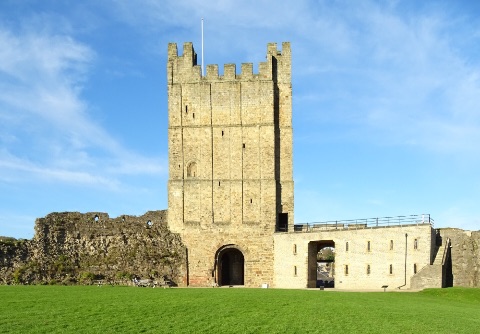
The ruins of Barnard Castle stand high above the Tees gorge on the edge of the County Durham town that grew up around it. Begun by Guy de Balliol to guard a river crossing, it was enlarged and rebuilt in stone by his nephew Bernard, who also founded the town that takes its name from him. The castle is a scheduled monument and Grade I listed.
The Balliols held it through the 13th century; Hugh de Balliol rebuilt the inner hall in stone and added the great chamber and the Round Tower, and King John stayed in 1216. John de Balliol was King of Scots from 1292 to 1296, and after his fall the castle passed out of the family. Later it belonged to Richard, Duke of Gloucester, the future Richard III, and Brackenbury Tower is named after Sir Robert Brackenbury, who died with Richard at Bosworth. In December 1569, during the Rising of the North, Sir George Bowes held the castle for Elizabeth I against a rebel army for 11 days before surrendering. In the 17th century Sir Henry Vane took stone from it for Raby Castle, and it fell into ruin. In the 1840s a man posing as a hermit lived in the Round Tower and showed people around. Lord Barnard placed the ruins in state guardianship in 1952.
A huge outer ward leads to the inner stronghold above the gorge. In the great chamber, Richard's emblem, the white boar, is carved above the oriel window, which looks down on the winding, tree-lined river. The Round Tower has a narrow spiral stair, and there are deep ditches, extensive lawns and a plot of young fruit trees.
The small shop sells gifts, cold drinks, ice cream and snacks, but there's no café. There's a single accessible toilet behind the shop, picnic benches with views over the gorge, and a play area. Dogs on leads are welcome. Most of the site is level grass and gravel, though the Round Tower and ditches involve steps. There's no parking at the castle; the nearest car parks are in the town, about 500 metres away. Entry is paid (free for English Heritage members), and opening days vary through the year, so check the English Heritage website before you go.
Sources & further reading
- English Heritage: Barnard Castle English Heritage
- English Heritage: Barnard Castle facilities English Heritage
- English Heritage: Directions to Barnard Castle English Heritage
- English Heritage: Access at Barnard Castle English Heritage
- English Heritage: History of Barnard Castle English Heritage
- Wikipedia: Barnard Castle (castle) Wikipedia
Links to other websites (the place's own site, CAMRA, Tripadvisor, map directions and sources) open in a new tab. We don't run those sites and aren't responsible for their content, so please check opening times, prices and access with the place before you travel. More about links