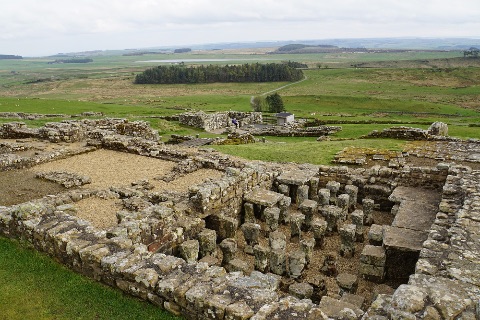
Chesters Roman Fort and Museum
🏛️ Museum🏰 History🎡 Family 👪 Child friendly🐕 Dogs outside only♿ Partly wheelchair accessible☕ Café
A Hadrian's Wall cavalry fort by the North Tyne, with Britain's best Roman bath house remains and a Victorian museum.
Chesters Roman Fort sits beside the North Tyne a quarter of a mile west of Chollerford, on the B6318. Built around AD 124 as a cavalry fort straddling the line of Hadrian's Wall, it is described by English Heritage as the best-preserved Roman cavalry fort in Britain, and its Victorian museum building is Grade II* listed.
The Romans called it Cilurnum. Its first garrison was a 500-strong cavalry unit, the ala Augusta, and by the late 2nd century the Second Asturians, raised in northern Spain, had taken over and stayed until the end of Roman rule. In 1796 Nathaniel Clayton bought the estate and landscaped over the remains, but his son John Clayton, who inherited in 1832, began excavating in 1843 and shaped much of what you see. His nephew Nathaniel George Clayton carried out the last major digs and opened the museum to house the family's collection. The fort and baths came into state guardianship in 1954.
Within the fort you can trace the gateways, the headquarters building with its strongroom (its vaulted roof still intact), the commanding officer's house and two barrack blocks, described as the clearest examples of auxiliary barracks anywhere in the Roman Empire. Down by the river, the bath house is reckoned the most complete set of Roman baths in Britain, and a viewing platform looks over the west end of the Roman bridge across the North Tyne. The Clayton Museum displays the collection gathered here.
The Coffee House has indoor and outdoor seating, and there's a shop, toilets with baby changing and picnic benches. Children can follow a trail hunting for hidden rubbing stones, and kites are allowed but ball games aren't. Dogs on leads are welcome but not in the museum. The site is generally flat, with ramps into the shop and museum and a free wheelchair on request, though there are steps down into the bath house. Parking is charged for non-members and free for members, and the AD122 bus stops at the fort. Entry is paid (free for English Heritage members); opening days vary through the year, so check the English Heritage website before you go.
The AD122 bus also links Chesters with Housesteads and Corbridge, and Hexham station is 5½ miles away.
Sources & further reading
- English Heritage: Chesters Roman Fort and Museum English Heritage
- English Heritage: Chesters plan your visit English Heritage
- English Heritage: Chesters facilities English Heritage
- English Heritage: Chesters directions English Heritage
- English Heritage: Chesters access English Heritage
- English Heritage: History of Chesters Roman Fort English Heritage
- English Heritage: Description of Chesters Roman Fort English Heritage
- Wikipedia: Chesters Roman Fort Wikipedia
Links to other websites (the place's own site, CAMRA, Tripadvisor, map directions and sources) open in a new tab. We don't run those sites and aren't responsible for their content, so please check opening times, prices and access with the place before you travel. More about links