Jarlshof
🏰 History🏛️ Museum🎡 Family🌊 Coast 👪 Child friendly · All ages🐕 Dogs on a lead🚫 Not wheelchair accessible
Headland site at Sumburgh in Shetland with over 4,000 years of layered prehistoric, Norse and laird's house remains.
Jarlshof sits on a low headland above the West Voe of Sumburgh, near the southern tip of the Shetland mainland, about an hour by bus from Lerwick. Cared for by Historic Environment Scotland, it holds remains of human settlement spanning more than 4,000 years, from around 2700 BC into the 17th century.
Successive generations built over earlier structures while wind-blown sand from nearby dunes sealed the layers until storms in the 1890s revealed the site, followed by excavations in the 1890s, 1930s and 1950s. Vikings from Norway settled in the 800s, farming across 12 to 16 generations before a later farmhouse, barn and corn kilns appeared by the late 1200s. After Shetland passed to Scotland in 1469, Earl Patrick Stewart ('Black Patie') built the Old House of Sumburgh in the 1500s, and Sir Walter Scott named the site Jarlshof in his 1822 novel The Pirate.
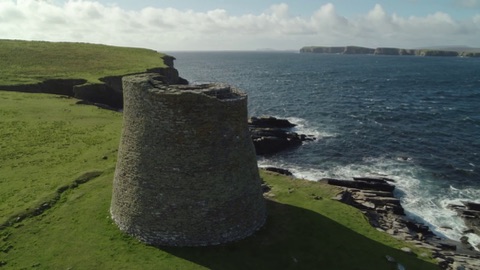
Visitors can trace overlapping stone ruins across the headland, including Bronze Age cellular houses and a smithy from around 800 BC, Iron Age roundhouses with souterrains, a broch tower now 2.4m high, an aisled roundhouse, a byre and four wheelhouses with radial walls. Above them rises the Old House of Sumburgh alongside the Norse longhouse remains.
The site includes a visitor centre, shop, audio guide, fact-finding quiz and water bottle refill, though there are no toilets on site (the nearest adapted toilet is at Sumburgh Airport). Dogs are welcome in outdoor areas and assistance dogs are permitted in roofed areas; parking uses the level gravel car park at the Sumburgh Hotel, and buses 6 and 6E run from Lerwick to Sumburgh.
Approach involves a steep 8m ramp and a 150m grass drive onto a level gravel path, with gravel and bound-stone paths across the site. Expect uneven ground, narrow 50cm low entrances in some Iron Age buildings, uneven stone steps without a handrail down to the wheelhouse, and a modern metal spiral staircase with a handrail to the top of the laird's house.
Sources & further reading
Links to other websites (the place's own site, CAMRA, Tripadvisor, map directions and sources) open in a new tab. We don't run those sites and aren't responsible for their content, so please check opening times, prices and access with the place before you travel. More about links